
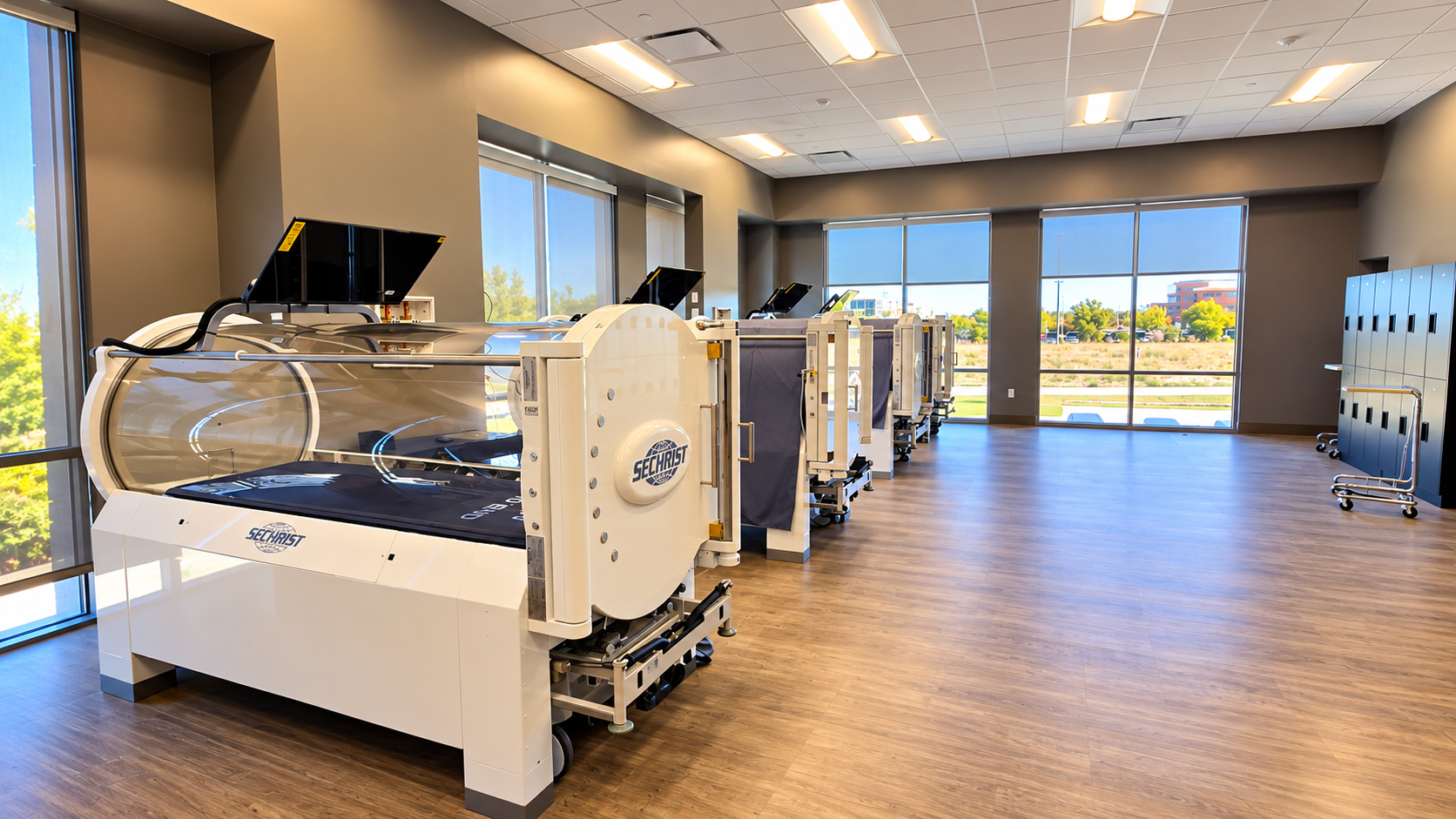
Hyperbaric oxygen therapy (HBOT) is offered by an increasing number of clinics across North Texas, and the term “hyperbaric” now appears on wellness spas, recovery studios, and mobile therapy listings alongside established wound care centers. But the equipment behind that label is not interchangeable. Understanding the difference between commercial-grade clinical HBOT and lower-pressure “mild” chambers can help patients and referring providers make informed decisions — and understand what insurers actually cover.
What Is Hyperbaric Oxygen Therapy (HBOT)?
HBOT is a medical treatment in which a patient breathes 100% pure oxygen inside a chamber pressurized above normal atmospheric pressure. Under pressure, oxygen dissolves directly into blood plasma and reaches tissues that may not receive adequate oxygen through normal circulation alone. The recognized, insurance-covered HBOT indications — including diabetic foot ulcers, radiation injury, compromised skin grafts and flaps, and chronic refractory osteomyelitis — are defined by specific treatment protocols.
Clinical-Grade vs. Mild Portable Chambers
Clinical-Grade Monoplace & Multiplace Chambers
Commercial-grade hyperbaric chambers used in hospital and outpatient wound care settings are FDA-cleared medical devices. They are designed to reach the higher pressures specified by established treatment protocols and to deliver 100% medical-grade oxygen. Treatments are supervised by trained hyperbaric technicians and ordering physicians, and sessions are documented as part of a patient’s medical record.
Mild / Portable “Soft” Chambers
Lower-pressure portable or “mild” chambers — often marketed for general wellness, recovery, or anti-aging — commonly operate at approximately 1.3 atmospheres absolute (ATA) and frequently use compressed room air (about 21% oxygen) rather than 100% oxygen. These chambers are not FDA-cleared for the recognized medical indications and are generally not reimbursable by Medicare or commercial insurance for wound care diagnoses.
Why the Difference Matters
The conditions for which HBOT is reimbursed are defined by specific treatment parameters — including the pressure reached, the concentration of oxygen delivered, session duration, and the total number of treatments. A chamber that operates at a lower pressure or delivers room air instead of 100% oxygen is not delivering the same treatment protocol that has been studied and recognized by Medicare and the Undersea and Hyperbaric Medical Society (UHMS).
This is why many clinics can advertise “hyperbaric oxygen therapy” while offering equipment that does not meet the parameters insurers require for covered wound care indications. The label alone does not tell you whether the treatment matches the established protocol for your diagnosis.
Key Facts at a Glance
- 2.0–2.4 ATA: typical treatment pressure for clinical-grade HBOT in wound care
- 100% oxygen: delivered in commercial-grade monoplace and multiplace chambers
- ~1.3 ATA: typical operating pressure of mild / portable soft chambers
- ~21% oxygen: room-air concentration used in some portable chambers (vs. 100% in clinical HBOT)
- 90–120 minutes: typical clinical HBOT session length
- Up to 60 sessions: typical treatment course for certain recognized indications
- 13–14 indications: the number of conditions recognized by the UHMS for HBOT
Questions to Ask Before Starting HBOT
If you are considering hyperbaric oxygen therapy for a wound or a recognized indication, asking a few direct questions can clarify what kind of treatment is being offered:
- What type of chamber do you use — a clinical-grade monoplace/multiplace chamber or a portable soft chamber?
- What pressure (in atmospheres absolute) is reached during a treatment session?
- Is 100% medical oxygen delivered, or is compressed room air used?
- Are treatments covered by my insurance for my specific diagnosis?
- Who supervises the treatments — a physician and trained hyperbaric staff?
Hill Wound Care’s Approach in Frisco, TX
Hill Wound Care – Frisco uses on-site commercial-grade monoplace hyperbaric chambers that deliver 100% medical oxygen under the pressures specified for recognized indications. Treatments are overseen by Tram Pham Hill, M.D. and a clinical hyperbaric team, and our staff verifies insurance benefits and manages prior authorization for covered diagnoses. Patients should always confirm coverage with their insurer before beginning treatment.